


















Customize Salesforce Make CRM Work Your Way.
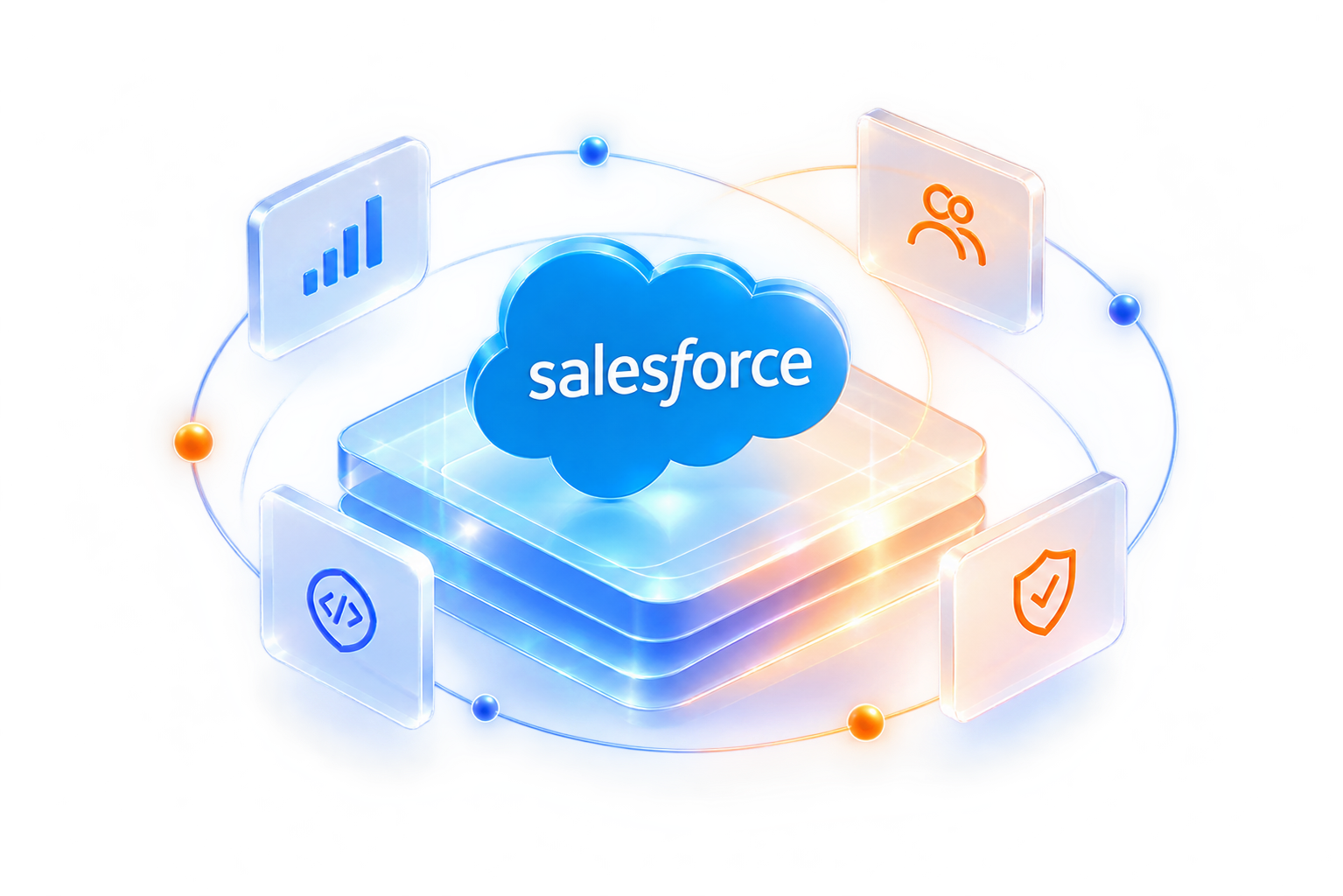
DianApps’ Salesforce customization services extend the platform where standard configuration does not fully satisfy your operating model. We design automation, Apex services, Lightning Web Components, user interfaces, reporting layers, integrations, and AI-enabled workflows.
Our Technology Partners
Let's make Salesforce work better for you
Tell us what you’re looking to achieve, and we’ll help you identify the right Salesforce solutions to move your business forward.
Salesforce Customization Services for Complex Business
We use a combination of declarative Salesforce capabilities and programmatic development to extend the platform without introducing unnecessary technical debt. Each customization is mapped to the underlying business process, data model, security model, integration boundary, and expected user interaction before implementation begins.
Data Model Design
We design and extend Salesforce data models with custom objects, fields, relationships, record types, and supporting structures that reflect your business information. The goal is to make critical data easier to capture, connect, govern, and use across teams without creating unnecessary complexity.
Custom Workflow Automation
We customize Salesforce workflows and automate repeatable business processes using Flow, approvals, validation rules, and related platform capabilities. Automation can reduce manual handoffs, standardize business rules, and trigger the right actions at the right stage of a process.
Custom Apex and LWC Development
When standard Salesforce capabilities cannot meet a requirement, we build custom functionality using Apex and Lightning Web Components. Our Salesforce customization specialists develop business logic, custom components, and tailored experiences while considering security, performance, governor limits, and long-term maintainability.
Custom User Interface Design
We tailor Salesforce interfaces around the roles, tasks, and information users work with every day. From page layouts and Lightning pages to custom components and navigation, we create focused experiences that make relevant actions and information easier to access.
Custom Reports and Dashboards
We build reports and dashboards around the metrics different teams need to monitor, analyze, and act on. Customized reporting can bring together relevant Salesforce data, role-specific views, filters, and visual summaries so decision-makers can work with information that supports their responsibilities.
Custom Third-Party Integrations
We extend Salesforce through integrations with business applications, APIs, middleware, and external data sources when standard connectivity does not meet the requirement. We consider data ownership, synchronization, authentication, error handling, and maintainability when designing the connection.
Custom AI-Powered Salesforce Solutions
We customize Salesforce environments to support AI-powered workflows, intelligent assistance, automation, and business-specific experiences. We align AI capabilities with available CRM data, permissions, processes, and governance requirements so the technology supports practical business use cases rather than adding complexity for its own sake.
Trusted by Businesses. Proven in Salesforce.
Recognized for the work we do, the value we create, and the standards we set.
Need Salesforce Beyond the Standard Setup?
Extend Salesforce around your workflows, users, data, and business logic with custom solutions designed for practical adoption and long-term scalability.
Create or extend custom objects, fields, relationships, record types, and data structures to support information that is specific to your business.
Customize page layouts, Lightning pages, navigation, actions, and custom components to create focused experiences for different user roles.
We set up Marketing Cloud journeys, segmentation, email, mobile and advertising studios, connected to CRM data for personalised campaigns and measurable engagement.
Build role-specific reports, dashboards, filters, and visualizations that surface the information teams need for operational and management decisions.
Automate repeatable processes, approvals, notifications, record updates, and task flows using Salesforce Flow and related automation capabilities.
Customize email templates and communication experiences around customer, sales, service, and operational workflows for consistent business communication.
Adapt Salesforce mobile experiences with relevant layouts, actions, navigation, and components so users can work effectively across mobile workflows.
Extend Salesforce with APIs, connected applications, external data sources, and integration logic when business processes require information to move across systems.
Refine search behavior, field visibility, record access, page layouts, and permission structures so users see the information and actions appropriate to their responsibilities.
Salesforce Aspects We Customize
Salesforce can be customized through its data model, user experience, business logic, automation, reporting, communications, mobile experience, and connected applications. We check the requirement first and select the appropriate combination of configuration, declarative tools, and custom development so the solution remains purposeful.
Objects & Fields
Automate repeatable processes, approvals, notifications, record updates, and task flows using Salesforce Flow and related automation capabilities.
Why Choose DianApps for Salesforce Customization
Our Salesforce consultants work across CRM strategy, cloud selection, architecture, data, integrations, automation, security, development, AI, and optimization. We bring advisory thinking together with technical understanding so recommendations can be translated into delivery plans.
What Salesforce Customization
Salesforce customization becomes valuable when the CRM reflects the way teams actually work. The right modifications can reduce process friction, improve data quality, make information easier to act on, and help teams use Salesforce more effectively without creating unnecessary complexity.
Greater Process Efficiency
Customize repetitive workflows and business rules to reduce manual steps, unnecessary handoffs, and process delays across everyday CRM operations.
Better User Adoption
Create interfaces, layouts, actions, and workflows that reflect user roles and responsibilities, making Salesforce more relevant and easier to use.
More Relevant Business Insights
Deliver role-specific reports and dashboards that focus attention on the metrics and information teams need to manage their responsibilities.
Scalable Business Processes
Build custom functionality around current requirements while considering future users, processes, integrations, and Salesforce platform changes.
Salesforce Configuration vs. Customization: What Does Your Business Need?
Salesforce configuration and customization solve different levels of business requirements. Configuration uses the platform’s available settings and declarative capabilities, while customization extends or modifies functionality when standard options cannot adequately support a specific process, experience, or business rule. The right choice depends on the business requirement, complexity, maintainability, and expected future changes.
Uses Salesforce’s available settings, layouts, fields, permissions, reports, and declarative capabilities.
Extends Salesforce with custom logic, components, interfaces, data structures, integrations, or specialized functionality.
Best when Salesforce already supports the required business process and the need is primarily structural, visual, or process-oriented.
Best when the requirement needs functionality or behavior that standard Salesforce configuration cannot adequately provide.
Objects and fields, page layouts, validation rules, reports, dashboards, permissions, Flow automation, and approval processes.
Apex logic, Lightning Web Components, custom objects and relationships, specialized UI, custom APIs, and advanced business logic.
Usually faster to implement and easier to adjust because it relies primarily on platform capabilities.
Generally requires greater design, development, testing, documentation, and release management.
Check whether the required outcome can be achieved cleanly with existing Salesforce capabilities before introducing custom development.
Check business value, complexity, security, performance, maintenance, release compatibility, and whether the custom requirement is essential.
Uses Salesforce’s available settings, layouts, fields, permissions, reports, and declarative capabilities.
Best when Salesforce already supports the required business process and the need is primarily structural, visual, or process-oriented.
Objects and fields, page layouts, validation rules, reports, dashboards, permissions, Flow automation, and approval processes.
Usually faster to implement and easier to adjust because it relies primarily on platform capabilities.
Check whether the required outcome can be achieved cleanly with existing Salesforce capabilities before introducing custom development.
Extends Salesforce with custom logic, components, interfaces, data structures, integrations, or specialized functionality.
Best when the requirement needs functionality or behavior that standard Salesforce configuration cannot adequately provide.
Apex logic, Lightning Web Components, custom objects and relationships, specialized UI, custom APIs, and advanced business logic.
Generally requires greater design, development, testing, documentation, and release management.
Check business value, complexity, security, performance, maintenance, release compatibility, and whether the custom requirement is essential.
Not Sure Whether You Need Configuration or Customization?
Let our Salesforce experts assess your requirements and identify the most practical path before you invest in custom development.
Our Salesforce Customization Process
Our Salesforce customization process moves from understanding the business requirement to designing, building, validating, and supporting the customized environment. Each stage focuses on the reason behind a requested change, its effect on users and existing Salesforce functionality, and the long-term maintainability of the solution.
- Discovery & Assessment
- Solution Design
- Customization & Development
- Testing & Quality Assurance
- Deployment & User Enablement
- Support & Continuous Optimization
Discovery & Assessment
We review your Salesforce environment, business workflows, users, pain points, existing customizations, and desired outcomes. This helps us distinguish essential requirements from changes that can be addressed through standard platform capabilities.
Solution Design
We translate requirements into a customization approach covering data structures, interfaces, automation, business logic, integrations, security, and dependencies. Where appropriate, we recommend configuration before introducing custom development.
Customization & Development
We implement the agreed changes using Salesforce configuration tools, Flow, Apex, Lightning Web Components, APIs, and other relevant platform capabilities. Development remains aligned with the approved architecture and business requirements.
Testing & Quality Assurance
We validate functionality, data behavior, permissions, integrations, user journeys, performance, and automation in controlled environments. Testing helps identify conflicts with existing Salesforce functionality before changes reach production.
Deployment & User Enablement
We move approved customizations through the required release process and support user readiness with documentation, guidance, and practical training where needed. The rollout is structured to minimize disruption to ongoing operations.
Support & Continuous Optimization
After launch, we address issues, review how the customized functionality performs in real workflows, and make improvements as requirements evolve. We also consider Salesforce releases and future dependencies when maintaining the solution
How We Address Salesforce Customization
Challenges
Salesforce customization can introduce complexity when changes are made without considering existing automation, data structures, security, performance, or future platform releases. We address these challenges by evaluating the current environment, prioritizing essential changes, testing dependencies, and designing custom functionality with maintainability in mind.
Over-Customization
Too many custom changes can make a Salesforce environment harder to maintain and upgrade.
Solution: We begin with requirement analysis and recommend standard configuration where it can achieve the intended outcome without unnecessary development.
Conflicting Automations
Multiple flows, validation rules, triggers, and processes can interact in unexpected ways.
Solution: We review existing automation and dependencies before introducing new logic, then test the combined behavior across relevant user journeys.
Performance Constraints
Complex custom logic or inefficient data operations can affect system responsiveness and processing.
Solution: We design with Salesforce platform limits in mind and keep custom components, queries, automation, and processing paths focused on the required outcome.
Release Compatibility
Salesforce releases can change platform behavior and introduce new capabilities that overlap with existing customizations.
Solution:
We document custom functionality, review relevant release changes, and plan updates so critical business processes remain supported.
Security & Access Complexity
Custom functionality must respect the organization’s data access model and user responsibilities.
Solution:
We account for permissions, field visibility, sharing, and access requirements while testing custom workflows and components against appropriate user roles.
Scaling Custom Solutions
A customization built for a narrow process may become difficult to extend as users, data, or business units grow.
Solution:
We use modular design, reusable components, clear documentation, and scalable data structures where the requirement justifies custom development.
Unclear Business Requirements
A technical request does not always describe the business problem accurately.
Solution:
We validate the desired outcome, users, process impact, and success criteria before deciding what should be configured, customized, integrated, or left unchanged.
Technologies Powering Our Salesforce Customization Services
Our Salesforce customization services are backed by technologies that extend platform capabilities, refine business workflows, and support complex enterprise requirements. From custom application logic and Lightning components to API integrations, data management, and automated deployments, we use the right tools to tailor Salesforce around your existing architecture and evolving business needs.


Find Out Our Salesforce Customization Success Stories
Explore how we’ve helped businesses customize Salesforce to address complex operational requirements, streamline workflows, and extend platform capabilities. These projects demonstrate our approach to solving business-specific challenges through tailored functionality, seamless integrations, and scalable Salesforce solutions.
Sinch 2
The Challenge:
Multiple communication channels needed scalable, secure customer experiences and salesforce app development services.
The Solution
Integrated Salesforce with advanced APIs, improved the platform's scalability and security, and enhanced overall usability.
The Impact:
Sinch1
The Challenge:
Multiple communication channels needed scalable, secure customer experiences and salesforce app development services.
The Solution
Integrated Salesforce with advanced APIs, improved the platform's scalability and security, and enhanced overall usability.
The Impact:

Sinch
The Challenge:
Multiple communication channels needed scalable, secure customer experiences and salesforce app development services.
The Solution
Integrated Salesforce with advanced APIs, improved the platform's scalability and security, and enhanced overall usability.
The Impact:

Salesforce Customization Services For Every Industry
Every industry has unique workflows, operational challenges, and customer expectations. Our Salesforce customization services adapt CRM features, data models, automation, dashboards, and user interfaces to your business requirements.
HEALTHCARE
Custom Salesforce objects, patient management workflows, and role-based dashboards help healthcare teams manage their day-to-day responsibilities. Tailored Health Cloud configurations, automated task assignments, and custom portals support patient coordination, provider communication, and administrative efficiency.
E-COMMERCE
Customized Salesforce components help eCommerce businesses manage product-related inquiries, abandoned carts, order exceptions, returns, and customer retention workflows. Tailored service processes, automation rules, customer dashboards, and business-specific data models improve visibility across online commerce operations.
Social Media
Custom Salesforce functionality helps social media businesses organize moderation requests, account issues, community interactions, and audience engagement workflows. Tailored case categories, automated routing, custom dashboards, and role-based interfaces support consistent handling of incoming requests and internal processes.
GAMING
Custom Salesforce functionality helps gaming businesses organize player support, community engagement, reward programs, and monetization-related workflows. Tailored objects, player segmentation rules, automated support routing, and engagement dashboards provide greater control over player relationships and retention activities.
FINTECH
Fintech-specific Salesforce customization accommodates customer onboarding, financial product applications, verification workflows, and service escalations. Custom objects, permission structures, approval processes, and dashboards help organize financial operations while supporting appropriate access controls and regulatory requirements.
FOOD DELIVERY
Customized Salesforce workflows help food delivery businesses manage order escalations, restaurant relationships, delivery exceptions, and customer complaints. Tailored dashboards, automated notifications, custom objects, and service rules give teams better control over fulfillment issues and partner operations.
SPORTS
Sports organizations can customize Salesforce around ticketing inquiries, membership renewals, sponsorship agreements, fan segments, and event operations. Tailored dashboards, custom data fields, automated campaign triggers, and workflow rules help teams manage supporter relationships and commercial activities.
Travel
Travel-focused Salesforce customization accommodates booking inquiries, itinerary changes, traveler preferences, loyalty rules, and service escalations. Custom record layouts, automated case routing, tailored dashboards, and workflow rules help travel teams manage changing customer requirements and reservation-related requests.
AUTOMOTIVE
Automotive Salesforce customization adapts dealer workflows, vehicle records, test-drive scheduling, warranty claims, and after-sales service processes. Custom Lightning components, tailored data models, automated approvals, and dealership dashboards help manufacturers and retailers manage vehicle-related customer journeys more efficiently.
Education
Customized Salesforce environments support enrollment workflows, course access requests, learner progress tracking, and institutional administration. Custom objects, automated reminders, role-based dashboards, and tailored Experience Cloud interfaces help education providers manage student interactions and academic support processes.
On-Demand
Customized Salesforce workflows help on-demand businesses manage bookings, provider assignments, cancellations, refunds, and service completion. Tailored status fields, automated escalation rules, custom dashboards, and scheduling-related components improve operational control across customer requests and fulfillment activities.
Business
Business-focused Salesforce customization aligns CRM functionality with internal approval processes, sales methodologies, account structures, and reporting requirements. Custom fields, Lightning components, automated workflows, and role-specific dashboards help teams manage their responsibilities without unnecessary manual steps.
Retail
Retail-focused Salesforce customization aligns CRM screens, inventory-related workflows, loyalty rules, and customer service processes with business requirements. Custom components, approval flows, dashboards, and automation help store teams manage promotions, customer inquiries, purchase histories, and omnichannel operations.
Real Estate
Property-specific Salesforce customization supports lead distribution, property matching, viewing schedules, deal stages, and tenant service requests. Custom objects, dynamic forms, automated follow-ups, and opportunity dashboards help agents manage property portfolios and coordinate transactions more efficiently.
Media & OTT
Media and OTT customization supports subscription changes, advertising workflows, subscriber inquiries, content-related requests, and audience management. Custom objects, tailored record pages, automated service rules, and reporting dashboards help teams manage subscriber relationships and media operations more effectively.
Logistics
Customized Salesforce workflows address shipment exceptions, delivery escalations, carrier coordination, account-specific service rules, and operational reporting. Tailored case classifications, custom dashboards, automated alerts, and shipment-related record structures help logistics teams manage exceptions and improve process visibility.
EV
EV-focused Salesforce customization supports charging-related inquiries, vehicle service appointments, warranty requests, dealership workflows, and ownership support. Custom objects, tailored service processes, automated alerts, and vehicle-specific dashboards help teams coordinate customer needs across electric mobility operations.
Fitness
Fitness-focused Salesforce customization supports membership plans, class bookings, trainer assignments, renewals, and member service requests. Custom objects, automated reminders, tailored dashboards, and membership-specific workflows help fitness businesses manage daily operations and deliver more relevant member experiences.
Putting Client Experience at the Center
DianApps has successfully launched the software and continues to make improvements. The team has delivered the project on time and has showcased flexibility throughout the engagement. Their responsiveness through virtual meetings, email, and messaging apps has impressed me a lot.
DianApps has designed and developed the app according to the our specifications. The team has delivered the project ahead of schedule and within budget. They communicate well through virtual meetings, emails, and a messaging app. Their ability to bring the my vision to life is impressive.
Thanks to DianApps' efforts, we're now closer to launching our product, aiming to deploy it by the end of the year. The team completed tasks on time and communicated clearly through virtual meetings. Their technical capabilities and flexibility have been crucial to the project's success.
The app is well-designed and user-friendly. DianApps maintained formal communication on a biweekly basis but made themselves available 24 hours a day. Their team met all the deadlines and immediately fixed any issues. They proactively informed the us of upcoming needs and steps.
We are pleased with the application; it’s easy to use and professional-looking. Moreover, we have developed a close relationship with DianApps. The team communicates seamlessly and adapts to meet the requirements. Overall, DianApps is responsive, reliable and attentive partners.
DianApps has delivered the application according to our requirements and ahead of schedule. Their solutions-driven nature and robust knowledge of the animal health sector have been hallmarks of this partnership. Despite the time difference, they’ve been responsive via WhatsApp.
DianApps successfully delivered a fully functional first version of the platform, including all core features. The platform is now stable, internally operational, and preparing for a public launch. The team communicated clearly, responded promptly, and delivered the work on time.

The completed deliverables have shown excellent quality and performance. DianApps consistently meets all project timelines. Overall, the team is understanding, prompt, and responsive. So far, I'm impressed with their overall performance.

Thanks to DianApps proven expertise, Thousand Greens is now functioning smoothly, including its core features. The team works thoroughly, ensuring each output is reviewed, tested, and delivered with the utmost quality.

DianApps for Committees is more like a partner than a development team that you just kind of use to build your MVP app. The team was cooperative and trustworthy, and did what they promised to implement on the Committees. They have been very impressive in their work.
I wasn’t satisfied with the support I received from my previous collaborators and so, I hired DianApps to design my app “Curu” from scratch. They helped me with quality, efficiency, attention to detail, and responsive app development while giving complete support to my app post its launch effortlessly.
I found DianApps by Googling the best React Native apps in India, and after the onboarding process with successful meetings, the team began with the app delivery and helped me launch VlogTalk within the promised time frame.
We have been working with DianApps for more than a year now to handle our entire technology development, and the team has amazingly delivered the work so far. I highly recommend DianApps as they are very genuine and easy to work with people I’ve ever met.
Salesforce Insights & Related Blogs
See how DianApps’ engineering expertise helps businesses build, improve and scale digital products.

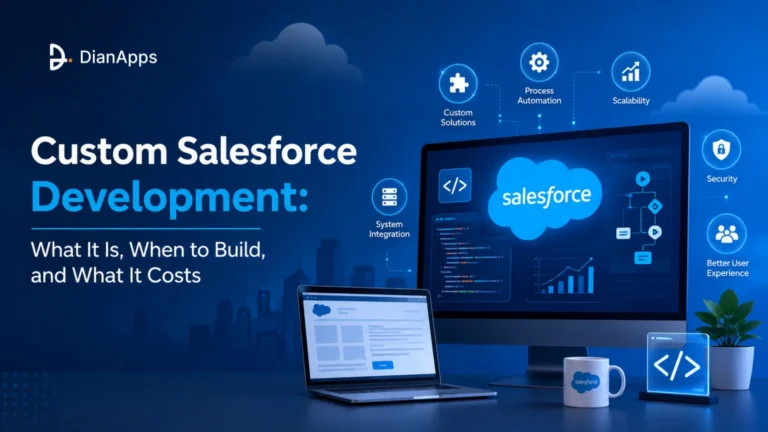
Custom Salesforce Development: What It Is, When to Build, and What It Costs
Most companies that commission custom Salesforce development don’t need as much of it as they buy. That isn’t a criticism of the buyers – it’s a criticism of how the…

The Power of Custom Salesforce Development for Scalable Business Growth
Discover how custom Salesforce development helps businesses scale with automation, integrations, and real-time insights. Learn why choosing the right Salesforce development company ensures long-term growth.
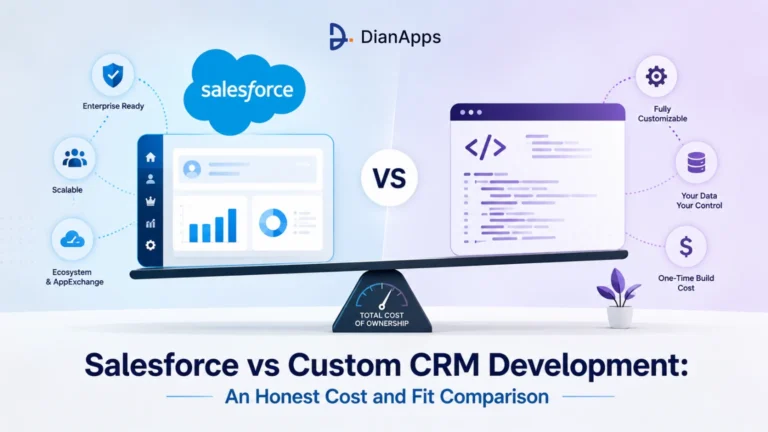
Salesforce vs Custom CRM Development: An Honest Cost and Fit Comparison
Key Takeaways: Salesforce costs scale with user count, while custom CRM costs are driven more by the initial build, maintenance, hosting and engineering requirements. Published Salesforce vs custom CRM break-even…

Frequently Asked Questions
Here’s a list of FAQs that will help you learn more about DianApps.
Salesforce configuration uses built-in settings and declarative tools, while customization extends the platform when standard capabilities cannot meet a specific business requirement. The right option depends on the complexity and nature of the desired outcome.
Services can include data model design, workflow automation, Apex and Lightning Web Component development, interface customization, reports and dashboards, third-party integrations, and AI-powered Salesforce solutions. The appropriate combination depends on the business requirement.
CRM customization means adapting a CRM platform's data structures, workflows, interfaces, automation, reporting, and functionality to match an organization's specific business processes, users, and customer operations.
Customization can improve workflow efficiency, user adoption, data quality, reporting relevance, and process consistency when the changes address genuine business requirements. It should be balanced with maintainability and the capabilities already available in Salesforce.
Evaluate the provider's Salesforce expertise, approach to requirements analysis, development capabilities, testing practices, security awareness, documentation, communication, and experience with environments similar to yours. A strong provider should also explain when configuration is preferable to customization.
Yes. Configuration can support sales processes through fields, page layouts, validation rules, Flow automation, permissions, reports, dashboards, and other standard capabilities. Customization becomes relevant when the required sales process goes beyond what configuration can reasonably support.
Agentforce capabilities can be tailored around business processes, data, permissions, and use cases, subject to the capabilities and controls available in the relevant Salesforce products. Customization should begin with a clear business outcome and appropriate data and governance requirements.
Cost depends on the number and complexity of customizations, the Salesforce products involved, development effort, integrations, data requirements, testing, and ongoing support. A focused configuration change and a custom Apex or LWC solution can require very different levels of effort.
The timeline depends on scope, complexity, dependencies, testing requirements, and the number of users or Salesforce products affected. Small changes may be completed quickly, while larger custom solutions require discovery, design, development, validation, and controlled deployment.
They can if custom logic, automation, data operations, or components are poorly designed or create unnecessary processing. Performance should therefore be considered during architecture and development, with testing used to identify issues before production.
Customization is appropriate when a business requirement is important, specific, and cannot be addressed effectively through standard Salesforce configuration. Before developing custom functionality, teams should assess whether existing platform capabilities can achieve the required result more simply.
Not every Salesforce environment needs extensive customization. If standard Salesforce capabilities can support the required workflow effectively, configuration may be the more practical option. Customization is most useful when a genuine business requirement remains after available configuration options have been evaluated.
A Salesforce customization partner should be able to explain its development capabilities, relevant Salesforce technologies, project experience, delivery approach, and industry familiarity. These details help determine whether the team can support the complexity and context of your specific requirement.
Project documentation and ownership arrangements should be defined as part of the engagement. The scope should clarify deliverables, source code or configuration ownership where applicable, documentation, access, deployment responsibilities, and post-launch support.